
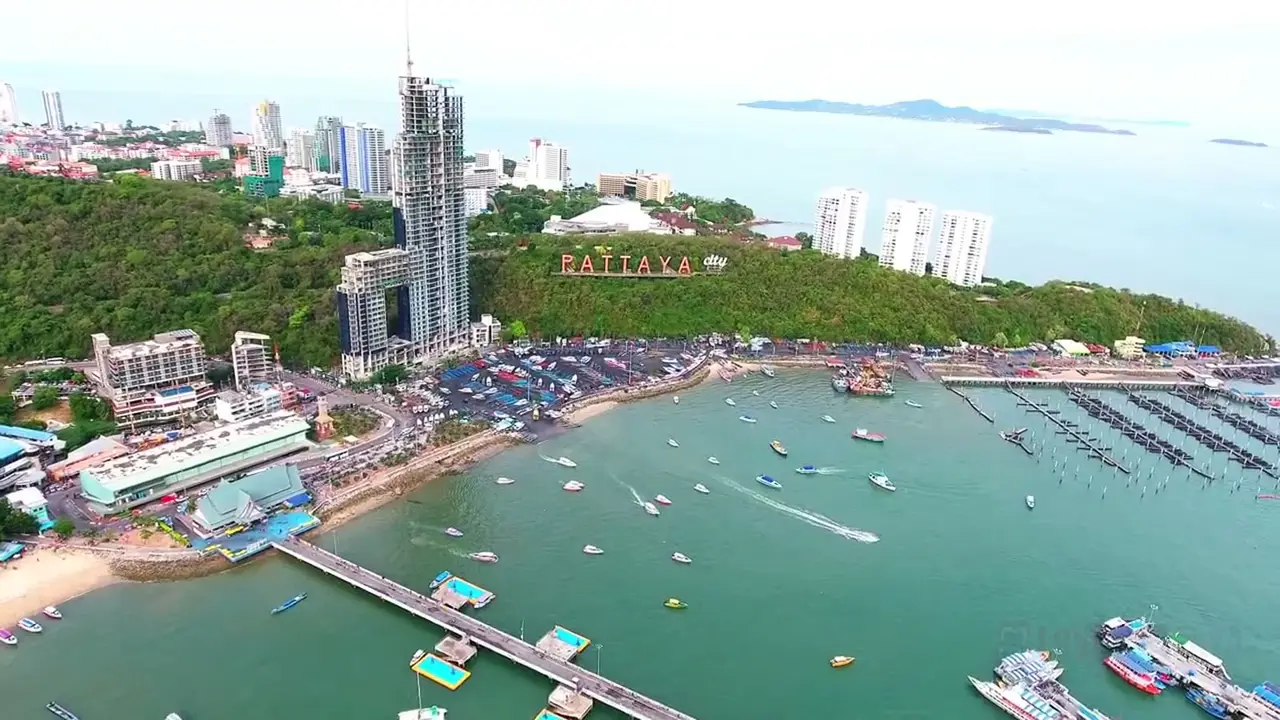
Pattaya history: the fishing village, the 1970s and Walking Street
How Pattaya grew from fishing village to resort city: the name, the first US servicemen, 1970s hotels, Walking Street, Beach Road and 1978 city status.
Updated 28 Nov 2026
Pattaya was a small fishing village until the 1960s. Tourism began when American servicemen came to its beach on rest and recreation leave during the Vietnam War era. The first big hotel opened in the mid-1960s, and on 29 November 1978 Pattaya became a self-governing city under its own Act.
Walking Street grew out of the fishing road at the south end of the beach. It was known as "The Strip" in the 1970s and became a pedestrian street at night in the 1990s. Beach Road's sand was rebuilt to about 35 metres wide in 2018.
Old dates for Pattaya often disagree from one source to the next. Where they do, we give both.
Before tourism: the fishing village and the name
Until the middle of the 20th century, Pattaya Bay was home to a few fishing families. The village was part of the Naklua area in Bang Lamung district. Pattaya Mail reports that in 1956 it came under Naklua and covered about 22.2 square kilometres. Naklua, to the north, still has a fishing community and wooden houses today.
The name has a story that is told locally and repeated by Wikipedia and Thaiways Magazine. It is tradition rather than recorded fact. In 1767, just before Ayutthaya fell to the Burmese, Phraya Tak, later King Taksin, marched his army towards Chanthaburi. Near the bay a local leader, Nai Klom, met him and surrendered without a fight. The place became known as Thap Phraya, "the Phraya's army". Over time the name changed to Phatthaya, the Thai word for the south-west wind that blows at the start of the rainy season, and then to Pattaya. Some retellings give the year as 1768; the sources we used say 1767.
The 1960s and 1970s: servicemen on leave and the first hotels
Thailand hosted large US air bases during the Vietnam War. Wikipedia says a large group of servicemen came from the base at Korat (Nakhon Ratchasima) on 29 June 1959 and rented houses at the south end of the beach. Word of mouth spread the name. Thaiways Magazine gives a different date: 29 April 1961, when about 100 servicemen arrived. Khaosod English has also reported April 1959. We cannot say which is right.
U-Tapao, near Sattahip, was built by the United States between October 1965 and June 1966 as a base for B-52 bombers. Servicemen from there also spent their leave in Pattaya.
The first large hotel was the Nipa Lodge on Beach Road. Kupi and Khaosod English date its opening to 1964. The hotel's own history says 1965. It was renamed Orchid Lodge in 1972 and is now Amari Pattaya. The Royal Cliff Beach Terrace followed in 1973 and the 527-room Royal Cliff Beach Hotel in 1974. TTG Asia says the Siam Bayshore, opened in 1974, was then one of just six hotels in Pattaya; its owners date it to 1975. Tiffany's Show began as a small cabaret in 1974.
Pattaya in 1978: what the town was like
For anyone doing the 1978 quiz, these are the facts we could source.
- City status: the Pattaya City Administration Act was enacted on 29 November 1978. It made Pattaya a special local administration run by a city manager, the only one of its kind in Thailand. Wikipedia also gives 30 October 1978 for the start of the special system.
- Why: in November 1976 the Bangkok Post reported that Pattaya, then a sanitation zone under Naklua, would become self-governing. Slums, pollution and crime had grown with the resort's popularity.
- Hotels: the Orchid Lodge, two Royal Cliff hotels, the Siam Bayshore and only a handful of others. Tiffany's cabaret was four years old.
- U-Tapao: the airfield had been running for about 12 years.
- Walking Street: not yet. The south end was "The Strip", open to traffic.
- Not built yet: the Sanctuary of Truth, begun in 1981.
- Population: we found no reliable published figure for 1978.
How Walking Street came about
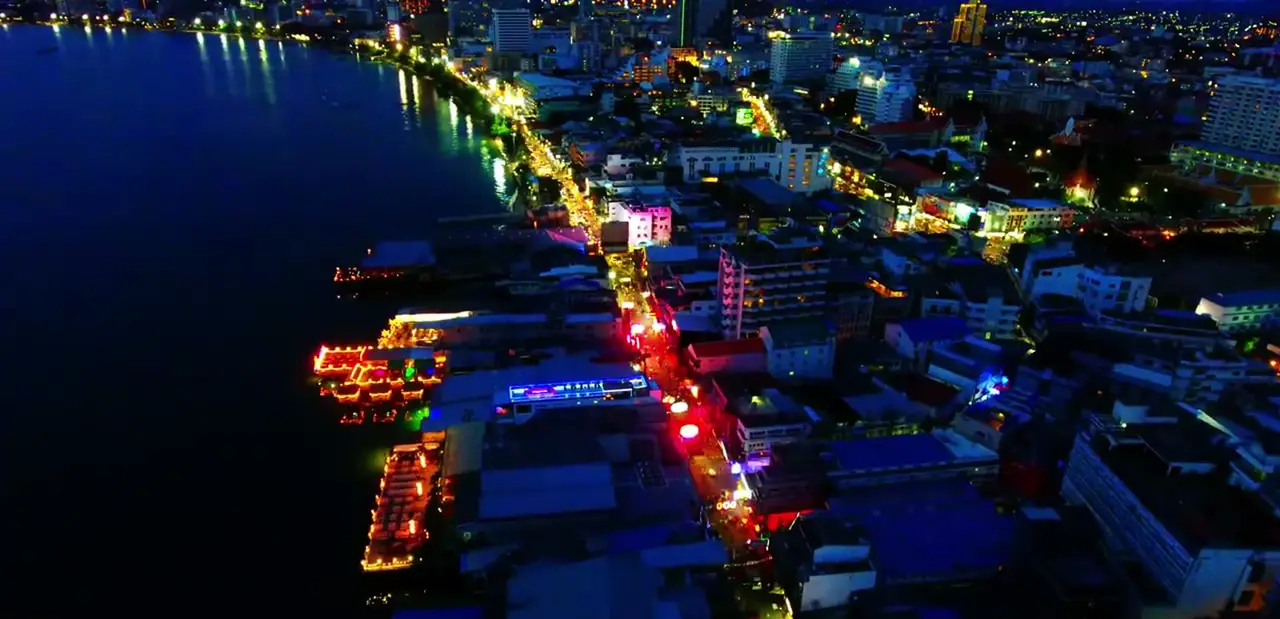
Walking Street runs for about a kilometre from the south end of Beach Road to Bali Hai Pier. Before tourism it was a road used by Pattaya's fishing trade, and seafood restaurants still line the sea side.
In the 1960s and 1970s hotels, bars and restaurants opened there for servicemen on leave, and the area was called "The Strip". Cabaret shows and discos followed in the 1980s. In the 1990s, after several road accidents, the city council closed it to vehicles in the evening, first from 6 p.m. That is when the name Walking Street stuck. We found no source that gives the exact year.
Today it is closed to traffic from 19:00 to 03:00. The large video sign over the Beach Road entrance went up in March 2010. TTG Asia says Bali Hai Pier is named after the Siam Bayshore's old restaurant opposite the pier.
Who remembers this beach? Beach Road through the decades
Pattaya Beach runs about 2.7 km from North Pattaya to the start of Walking Street. Beach Road follows it the whole way. Pattaya Mail reports the road has been widened once before, a job that took nearly a year.
The beach was once about 35 metres wide. Erosion cut it to a thin strip of 2 to 3.4 metres in places, with the sea close to the road. In 2018 the Marine Department rebuilt it. The Nation reported in August 2018 that more than 360,000 cubic metres of sand was brought from about 20 km offshore to restore the 35-metre width. The budget was 420 million baht in that report and 429 million in the Bangkok Post. In August 2018 heavy rain and flooding washed out part of the new sand and had to be repaired. The plan was to top up the sand about every five years.
The footpath works came later than many remember, in the 2020s rather than the 2010s. In 2020 Pattaya Mail reported a 170 million baht plan for parking, trees, lighting and toilets. In 2023 contractors rebuilt the walkways on both sides, added foot showers and lighting and resurfaced the road, aiming to finish by October 2023.
Guess the year: clues in an old aerial photo
- A narrow strip of sand with the sea close to Beach Road suggests before the 2018 rebuild. A wide, even beach suggests 2018 or later.
- A large video sign at the Walking Street entrance means March 2010 or later.
- Royal Cliff's hotels on the headland mean 1973 or later.
- Very few tall buildings and a low-rise beachfront point to the 1960s or 1970s. High-rise condominiums spread in the 1990s.
- The Sanctuary of Truth in Naklua dates from 1981 onwards.
Municipal history and population
Pattaya began under the Naklua sanitation district, set up in 1956 and extended to South Pattaya in 1964, according to a Chulalongkorn University thesis. The 1978 Act made it a special city with a city manager. Its first mayor, Sathap Keyanon, took office in November 1978. A new Act in 1999 created an elected council and mayor. Nirun Wattanasartsaton was the first mayor chosen by direct vote, in 2004.
The table shows registered residents, from the Department of Provincial Administration, with the January 2025 figure from Wikipedia. These counts leave out many people who live in the city without registering, so the real figure is much higher. Wikipedia gives 351,391 for greater Pattaya in 2021.
| Year | Registered residents |
|---|---|
| 2005 | 95,487 |
| 2010 | 107,944 |
| 2015 | 115,840 |
| 2019 | 119,532 |
| 2025 (January) | 116,417 |
The Golden Man
Reliable sources on Pattaya's "Golden Man" are thin. We found no report in a mainstream newspaper. The local blog Pattaya Unlimited describes him as the "Glitter Man", also called "The Golden Man" or "Golden One". He was a well-known sight cycling around the city on a colourful bicycle. The blog's last photo of him is dated March 2012, and it says he was later reported to have gone back to the United Kingdom.
We have not found a public name for him, so we do not give one. If you remember him from Beach Road or Walking Street and have a dated photo, we would like to hear from you.
The Michael Jackson of Walking Street
Pattaya Mail profiled Walking Street's Michael Jackson impersonator in March 2011. He was known as Om. He had come to Pattaya about three years earlier and started entertaining tourists with card tricks, dancing and singing, inspired by the street's other performers.
After Jackson's death in 2009 he built a full tribute act, with the look and the moonwalk. Pattaya Mail said he usually performed on Walking Street from about 7 p.m. We found no more recent reliable report, so we cannot say whether he still performs.
Pattaya today
Today's Pattaya is a city of high-rise hotels and condominiums, with a rebuilt beach, a convention centre and millions of visitors a year. It is part of the Eastern Economic Corridor development area. Walking Street is still the best-known street, but the city now works to draw families with shows, theme parks, islands and an events calendar that runs all year.
Things to do in Pattaya →Pattaya nightlife →Events in Pattaya →
Questions people ask
When did Pattaya become popular?
In the 1960s, when American servicemen began coming on leave during the Vietnam War era. Sources give the first arrival as 29 June 1959 or 29 April 1961. The resort grew fastest in the 1970s and 1980s.
What does Pattaya mean?
Phatthaya is the Thai word for the south-west wind at the start of the rainy season. Local tradition says the name grew out of Thap Phraya, "the Phraya's army", after the future King Taksin camped there in 1767.
When did Pattaya become a city?
The Pattaya City Administration Act was enacted on 29 November 1978. It made Pattaya a special self-governing city run by a city manager.
When did Walking Street start?
The area was known as The Strip from the 1960s. In the 1990s the city closed it to traffic in the evening and it became Walking Street. We found no source with the exact year.
What was Pattaya's first hotel?
The Nipa Lodge on Beach Road, opened in 1964 or 1965 depending on the source. It became the Orchid Lodge in 1972 and is now Amari Pattaya.
Who is the Golden Man of Pattaya?
A street character also known as the Glitter Man, remembered for cycling around the city on a colourful bicycle. A local blog says he was last photographed in March 2012 and later returned to the UK. Reliable sources are few.
Who is the Michael Jackson impersonator on Walking Street?
Pattaya Mail profiled him in March 2011 as Om, a young performer who moonwalked and sang on Walking Street from about 7 p.m. We found no recent report.
When was Pattaya Beach widened?
In 2018 the Marine Department rebuilt the 2.7 km beach to about 35 metres wide with more than 360,000 cubic metres of sand.
Read next
Walking Street →Beach Road →Naklua and Wongamat →Things to do in Pattaya →Pattaya nightlife: the areas, the shows and what time bars close →Pattaya's airport: U-Tapao (UTP) →Events →
- Wikipedia: Pattaya
- Wikipedia: Walking Street, Pattaya
- Wikipedia: U-Tapao International Airport
- Wikipedia: Mayor of Pattaya City
- Thaiways Magazine: Pattaya history
- Khaosod English: How Pattaya went from fishing village to global tourist hotspot (3 Sep 2026)
- Kupi: history of Pattaya
- Amari Pattaya: about us (hotel history)
- Royal Cliff Hotels Group: hotel history
- TTG Asia: 50 and fabulous, Siam Bayshore Resort Pattaya (17 Jul 2024)
- Pattaya Mail: Tiffany's Show, 50 years
- Bangkok Post Thailand Journey: Pattaya gets status of independent city (5 Nov 1976)
- Pattaya Mail: Pattaya marks 45 years as special administrative city (Nov 2023)
- Chulalongkorn University thesis on Pattaya City administration
- Pattaya Mail: PCEC member shares 1970s USO experiences at U-Tapao (14 Jan 2015)
- The Nation: Eroded Pattaya Beach gets reconstructive surgery (22 Aug 2018)
- Bangkok Post via PressReader: Pattaya City beach sand-fill project hit hard by flooding (7 Aug 2018)
- Pattaya Mail: Pattaya Beach facelift to widen Beach Road again (4 Oct 2020)
- Pattaya Mail: Pattaya accelerates Beach Road completion for high season (31 Aug 2023)
- City Population: Pattaya registered population (Department of Provincial Administration)
- Pattaya Unlimited: Glitter Man's last ride
- Pattaya Mail: Michael Jackson spotted on Pattaya's Walking Street (10 Mar 2011)